PARENT GUIDE
Books for 6-Year-Olds Who Can Read but Do Not Want To
8 min read · Published Aug 29, 2026 · Updated Aug 23, 2026A practical, shame-free guide for families navigating early independent-reading resistance, with a story-led routine designed for children ages 6.
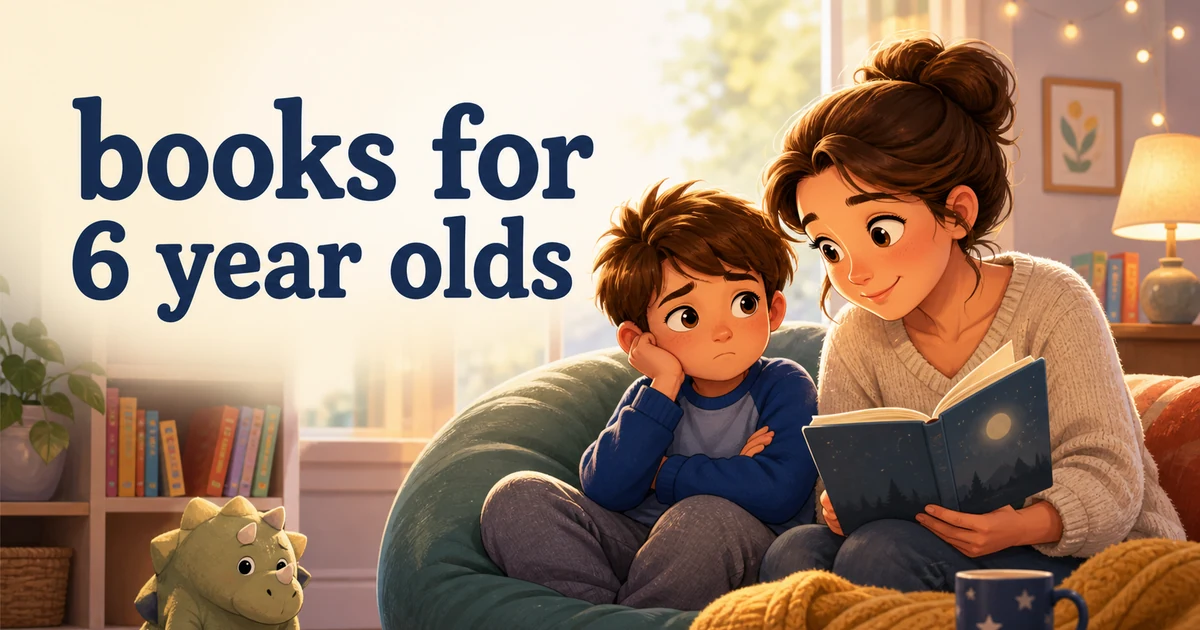
This topic becomes useful when it connects a broad search to a specific family moment. Here, that moment is early independent-reading resistance; the practical bridge is shared ownership of harder pages, with reader identity as the learning focus.
Why a story can help
A young child experiences a story through rhythm, image, prediction, and relationship—not through a moral statement alone. When the reading leaves space to notice and wonder, the child can build an internal model of reader identity instead of merely borrowing the adult's answer.
A shared story also gives adults information. The detail a child notices, avoids, repeats, or changes can reveal how they understand early independent-reading resistance. That observation should guide the next conversation more than a generic moral should.
Narrative gives a child psychological distance. It is often easier to consider what a fox, astronaut, or ordinary classmate might do than to discuss one's own difficult moment directly. That distance protects dignity while still making reader identity available for reflection.
Fiction allows rehearsal without immediate real-world cost. A character can misunderstand, pause, ask for support, or try again while the child studies the sequence from a safe distance. This makes reader identity discussable before it is urgently needed.
Reading together also regulates pace. Unlike a fast real-world conflict, a page can be revisited and a decision can be examined. That slower timescale gives 6-year-olds room to understand early independent-reading resistance.
A story can normalise struggle without normalising harm. The child sees that difficult feelings and imperfect attempts are part of learning, while the plot still protects boundaries and consequences. That balance is central to credible teaching about reader identity.
Read the need before choosing the book
Check for conflicting adult expectations. If caregivers use different rules or cues, a child may be navigating ambiguity rather than refusing. Agree on one simple version of shared ownership of harder pages.
Check the emotional temperature. If either adult or child is already overwhelmed, teaching is unlikely to land. Regulate first, reconnect second, and bring in the story later when curiosity has returned.
Ask how much language the moment demands. During early independent-reading resistance, the child may need a gesture, picture, or two-word cue before they can use a complete sentence about reader identity.
Notice whether the problem appears everywhere or only in one setting. A context-specific pattern often points to a mismatch in demand, relationship, or cues. Use the story to rehearse the relevant setting rather than assigning the child a global label.
Distinguish a missing skill from a competing need. A child may understand the expected action while needing rest, reassurance, sensory relief, or reconnection first. Meeting that need can make teaching possible.
Look at the environment as carefully as the child. Noise, timing, hunger, competing screens, unclear expectations, and adult hurry can all intensify early independent-reading resistance. A story cannot compensate for a routine that asks more than the child can currently manage.
What to look for
Read the metadata critically. Age labels are rough guides, not guarantees. Preview the actual vocabulary, tension, assumptions, and resolution against the needs of 6-year-olds.
Use cultural and family fit as a quality criterion. Children should encounter both mirrors of familiar life and windows into other lives, but unfamiliar practices deserve context rather than being treated as decoration.
Look for complexity appropriate to the reader. A story may show that two feelings coexist, a kind choice still disappoints someone, or help is brave. Nuance makes reader identity credible rather than sentimental.
Choose a protagonist who struggles before succeeding. Perfect characters create distance; credible characters make an imperfect attempt, receive information or support, and change strategy. That arc supports reader identity without implying that worth depends on performance.
For digital stories, assess the interface as part of the text. Ads, autoplay, rewards, and excessive animation compete with joint attention. Full-screen reader mode and a preselected endpoint make conversation easier.
Check whose experience is centred. Stories about difference, disability, culture, or family structure should give affected characters full motives and agency rather than using them merely to teach another character a lesson.
How to read it without turning it into a lesson
Invite the child to choose where to pause. Their selected moment may reveal humour, confusion, fear, or identification that an adult-led discussion would overlook.
If the child rejects the story, do not sell it harder. Ask whether the problem is the topic, length, mood, or timing. Choosing a different story preserves trust and teaches that reading preferences can be expressed respectfully.
When several children share the story, vary the doorway into it. One may repeat a line, one may track the problem, and another may watch the pictures. Equal participation does not require identical participation.
Follow the child's mode of participation. They may listen while moving, point at pictures, supply repeated words, or interrupt with a personal connection. Participation does not need to look still or school-like to be meaningful.
Invite prediction with a reversible prompt: “I wonder what might happen.” If the child does not respond, offer your own thought and keep going. Silence can still be engaged listening.
Introduce the story without announcing a lesson. “I found a story about someone facing a tricky moment” invites attention; “You need this because of what you did” invites defence. Keep the first reading focused on plot and enjoyment.
Move from story to practice
Notice a real-life echo without weaponising the book: “This feels a little like the bridge scene. Do you want the same help the character used, or something different?” The child remains an agent, not a character being compared unfavourably.
Replay only the turning point with toys. Keep the setup identical and change one character action. The visible contrast helps a child connect choice with consequence without reliving the entire conflict.
Invite a personal connection only after giving permission to pass. “Does this remind you of anything, or should we keep it in the story?” protects distance while making transfer available.
Use a three-box sequence labelled before, hard moment, and next step. Draw or write one detail in each box. This externalises the chain and reduces the working-memory demand when early independent-reading resistance happens quickly.
Plan a supported real-world trial and an exit. Tell the child what they can try, what help looks like, and how to pause. Knowing there is a safe way out can make shared ownership of harder pages easier to attempt.
After reading, rehearse shared ownership of harder pages for no more than two minutes. Let the child play the character, then swap roles. End while the attempt still feels possible; the purpose is to make the response familiar, not to prove mastery.
What progress actually looks like
Invite the child to rate usefulness with words, faces, or a simple thumbs scale. “Did this story help a lot, a little, or not yet?” teaches reflective choice and improves future selection.
Notice whether repair begins sooner. A child who still makes mistakes but returns, checks impact, or accepts reconnection is developing a crucial part of reader identity.
Review the adult side of the plan too. Did cues arrive earlier? Was the request smaller? Did the adult remain available for co-regulation? Story-led practice works within a system, not on the child alone.
Review whether the chosen goal remains relevant. Sometimes early independent-reading resistance changes once adults understand it better. Updating the goal is responsive practice, not moving the finish line.
Use the child's spontaneous references as evidence. Mentioning a character, repeating a line in play, or proposing a different ending suggests that the narrative has become available for thinking.
Ask whether the child can describe what made the attempt easier. Recognising useful conditions—more warning, fewer steps, a calm adult, or a visual cue—builds self-knowledge alongside reader identity.
Important limits
A story is not an assessment or treatment. Seek qualified support when the pattern is intense, persistent, unsafe, distressing, or interferes with daily life across settings.
Keep private details private. Personalisation needs only enough context to create relevance; names, locations, school identifiers, diagnoses, and family events should not be entered into a tool without a clear need and privacy review.
Do not introduce the book during a meltdown, use it as a consequence, or ask why the child cannot behave like the protagonist. Regulate and reconnect first. Return later when the story can be experienced as support.
Separate general guidance from individual advice. Culture, language, disability, neurotype, trauma history, and family context can change what support is appropriate.
Be cautious with absolute developmental timelines. Children vary widely, and a range printed on a book cannot diagnose delay or readiness. Discuss genuine concerns with a qualified professional.
Respect refusal when a topic feels too close. Offer distance through fantasy, a different character, or a later time. Emotional safety is part of relevance, not an obstacle to the lesson.
Try a matched TalePillow story
Explore the TalePillow story library for a ready-made narrative connected with reader identity. If the challenge is highly specific, create a personalized story using a familiar interest, one believable obstacle, and shared ownership of harder pages. Always preview the result before sharing it with a child.
Two questions families often ask
What if my child will not answer questions? Comment instead of questioning: “I noticed the character moved closer to the door.” Children can participate by looking, moving, repeating, or listening.
Should siblings read the same story? They can, but use layered participation. A younger child may point or repeat; an older child may infer motives or compare choices.
Sources and further reading
- American Academy of Pediatrics: shared reading guidance
- Harvard Center on the Developing Child: executive function
The goal is not to use a story to make a child comply. It is to make reader identity easier to understand, discuss, and practise while protecting connection. For early independent-reading resistance, begin with shared ownership of harder pages and adjust from what the child shows you.
Turn Your Child into the Hero of Their Own Storybook
Upload a single photo to create a bespoke 16-page 3D illustrated adventure with character likeness, bedtime audio narration, and instant print-ready PDF in 2 minutes.