PARENT GUIDE
Why Your Child's Bedtime Routine Stops Working—and How Stories Can Reset It
8 min read · Published Aug 26, 2026 · Updated Aug 23, 2026A practical, shame-free guide for families navigating an inconsistent wind-down, with a story-led routine designed for children ages 3–8.
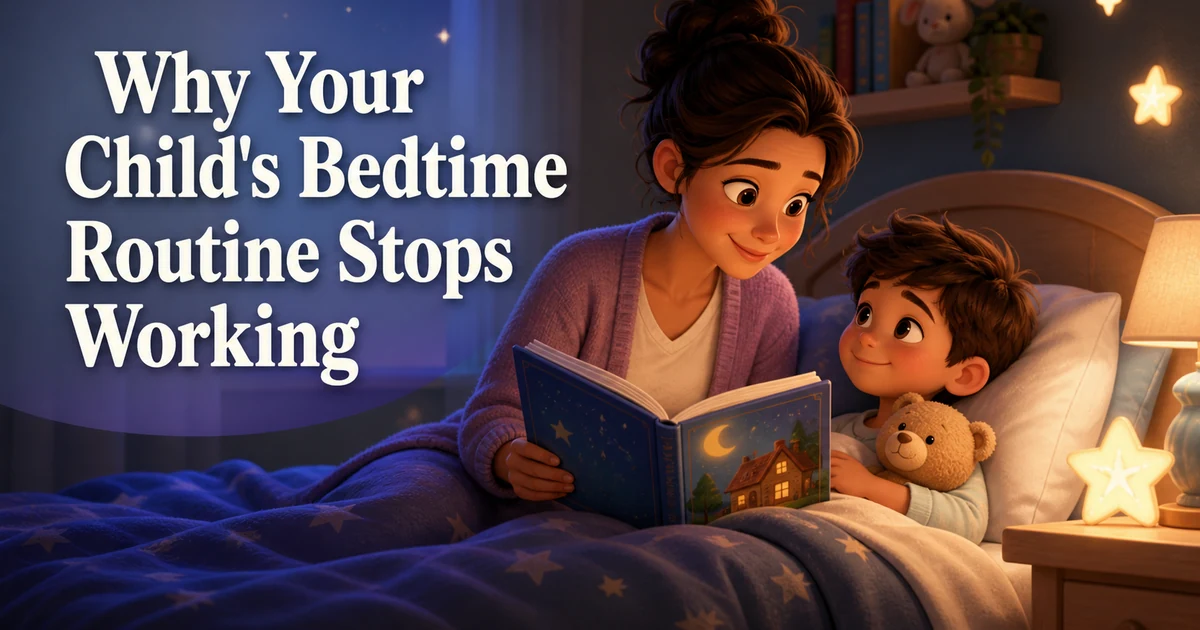
The strongest bedtime routine for kids do two jobs at once: they hold a child's attention and give the family language for something that matters. When an inconsistent wind-down, use a seven-night routine reset so the lesson remains visible without becoming a lecture.
Why a story can help
Memory favours connected events over isolated advice. A distinctive setting, character goal, obstacle, and outcome create retrieval cues that can later bring a seven-night routine reset to mind during ordinary life.
Children can repeat a rule before they can use it under pressure. Working memory, impulse control, language, and emotional regulation develop gradually. Stories reduce the demand by showing predictable transitions inside a sequence: a character notices a problem, tries something, sees the effect, and adjusts.
A young child experiences a story through rhythm, image, prediction, and relationship—not through a moral statement alone. When the reading leaves space to notice and wonder, the child can build an internal model of predictable transitions instead of merely borrowing the adult's answer.
The adult-child interaction carries much of the benefit. A modest story read responsively can be more valuable than an award-winning book rushed through as a task. Following the child's gaze, question, or laugh tells you where meaning is forming.
Choice improves engagement when it is bounded. Offering two suitable stories—or two ways to participate—preserves the adult's responsibility for safety and fit while giving the child meaningful agency. That is often more effective than either total control or unlimited choice.
A shared story also gives adults information. The detail a child notices, avoids, repeats, or changes can reveal how they understand an inconsistent wind-down. That observation should guide the next conversation more than a generic moral should.
Read the need before choosing the book
Check whether the request contains hidden steps. A seven-night routine reset may require noticing a cue, stopping another action, remembering words, and tolerating uncertainty. Support the earliest missing link instead of repeating the final instruction.
Consider whether success has become too emotionally loaded. Heavy praise, visible disappointment, or repeated discussion can make an attempt feel like a test. Lower the stakes so information and practice can replace performance.
Consider what the child already does successfully. A small existing strength—asking for help with one adult, waiting briefly in a game, remembering one routine step—can become the bridge into the new story.
Observe recovery, not only escalation. What helps the child return—space, closeness, movement, humour, or a clear plan—can inform both the story's ending and the family's next response.
Listen for the child's interpretation. “I hate reading” may mean the text is difficult, the topic feels imposed, the questions feel like tests, or stopping play is painful. Respond to the meaning beneath the sentence, not only the sentence itself.
Compare the moments that go well with those that do not. Differences in time, people, preparation, and sensory load often reveal a usable support that a story can mirror.
What to look for
For sensitive topics, choose a degree of distance. An animal fantasy may feel safer than a realistic classroom scene, while some children prefer direct and concrete representation. Let response guide the choice.
Reject stories that solve the problem through humiliation, fear, or sudden personality change. A useful ending shows support, practice, repair, or a realistic next step—not obedience produced by shame.
Consider the supporting characters. Helpful adults and peers should guide without taking over, set boundaries without humiliating, and allow the protagonist to retain meaningful agency.
Read the metadata critically. Age labels are rough guides, not guarantees. Preview the actual vocabulary, tension, assumptions, and resolution against the needs of children ages 3–8.
Use cultural and family fit as a quality criterion. Children should encounter both mirrors of familiar life and windows into other lives, but unfamiliar practices deserve context rather than being treated as decoration.
Look for complexity appropriate to the reader. A story may show that two feelings coexist, a kind choice still disappoints someone, or help is brave. Nuance makes predictable transitions credible rather than sentimental.
How to read it without turning it into a lesson
Read dialogue slightly more slowly than narration and leave a beat after emotionally important lines. A pause gives the child time to interpret tone, face, and consequence before the plot moves on.
Use the illustration before supplying an emotion label. Ask what the face, hands, distance, or colour suggest. Evidence-based noticing supports inference and makes room for interpretations beyond the adult's first idea.
Use one planned pause near the character's decision. Ask, “What have you noticed?” or “What might happen next?” A genuine question has more than one defensible answer and does not require the child to guess the adult's preferred moral.
Give unfamiliar words enough context to work. Briefly explain only what blocks the plot, then continue. Over-explaining every term fragments the narrative and can make the child feel examined.
If attention fades, summarise the current problem and offer a choice: stop, skip ahead, or continue later. Protecting agency makes a future return more likely than insisting on completion.
Let the child's answer change the pace. A surprising observation deserves attention even if it is not in the reading plan. Responsive reading is a conversation organised around a book, not a performance of the book.
Move from story to practice
Invite a personal connection only after giving permission to pass. “Does this remind you of anything, or should we keep it in the story?” protects distance while making transfer available.
Build a tiny bridge into the next day. Place a visual cue where the challenge occurs, plan one supported attempt, and tell the child when help will be available. The environment should carry part of the memory load.
Notice a real-life echo without weaponising the book: “This feels a little like the bridge scene. Do you want the same help the character used, or something different?” The child remains an agent, not a character being compared unfavourably.
Practise at half difficulty. Shorten the wait, reduce the number of steps, or role-play with a cooperative partner. Successful small repetitions build a pathway that can later survive a harder context.
Ask the child to rank three possible responses for safety, kindness, and usefulness. There may not be one winner. Explaining the trade-off turns predictable transitions into judgment that can travel across contexts.
Let the family create a sequel set one week later. Ask what the character remembers, still finds difficult, and does when the first plan fails. A sequel presents learning as ongoing rather than magically complete.
What progress actually looks like
Track leading indicators: noticing the situation earlier, accepting help sooner, using one new phrase, or recovering more quickly. These changes show that predictable transitions is becoming accessible even before the whole pattern changes.
Use the child's spontaneous references as evidence. Mentioning a character, repeating a line in play, or proposing a different ending suggests that the narrative has become available for thinking.
If no useful signal appears after repeated readings, change one variable: the story, timing, question, or practice step. Persistence does not mean repeating an ineffective setup unchanged.
Stop using the story when it has done its job or becomes irritating. A resource can be useful and still have an endpoint. Keep the skill cue, thank the story, and make room for new interests.
Ask whether the child can describe what made the attempt easier. Recognising useful conditions—more warning, fewer steps, a calm adult, or a visual cue—builds self-knowledge alongside predictable transitions.
Look for increased choice quality. Moving from an impulsive reaction to naming two possible actions is progress, even when the child still needs help selecting the safer one.
Important limits
Pause if the child becomes distressed, unusually quiet, or eager to leave. Offer comfort and choice without demanding an explanation. A topic can be revisited later with more distance or appropriate support.
Do not introduce the book during a meltdown, use it as a consequence, or ask why the child cannot behave like the protagonist. Regulate and reconnect first. Return later when the story can be experienced as support.
Respect refusal when a topic feels too close. Offer distance through fantasy, a different character, or a later time. Emotional safety is part of relevance, not an obstacle to the lesson.
Verify factual and safety instructions outside the story. Narrative aids memory, but road, water, body, emergency, health, and online-safety guidance should align with current authoritative advice where the family lives.
Avoid fixed labels such as lazy, selfish, shy, naughty, or “a bad reader.” Describe the specific moment instead. Behaviour can change; identity labels make change feel less available.
Do not over-interpret one response to fiction. A child may enjoy a villain, laugh from discomfort, or invent a dark ending without endorsing it. Look for patterns and ask curious, non-alarming questions.
Try a matched TalePillow story
Explore the TalePillow story library for a ready-made narrative connected with predictable transitions. If the challenge is highly specific, create a personalized story using a familiar interest, one believable obstacle, and a seven-night routine reset. Always preview the result before sharing it with a child.
Two questions families often ask
What if my child will not answer questions? Comment instead of questioning: “I noticed the character moved closer to the door.” Children can participate by looking, moving, repeating, or listening.
Can a personalized story change behaviour? It can make a skill more relevant and memorable, but it cannot guarantee change. Treat it as one rehearsal tool inside a supportive routine.
Sources and further reading
- American Academy of Pediatrics: shared reading guidance
- Harvard Center on the Developing Child: executive function
The goal is not to use a story to make a child comply. It is to make predictable transitions easier to understand, discuss, and practise while protecting connection. For an inconsistent wind-down, begin with a seven-night routine reset and adjust from what the child shows you.
Turn Your Child into the Hero of Their Own Storybook
Upload a single photo to create a bespoke 16-page 3D illustrated adventure with character likeness, bedtime audio narration, and instant print-ready PDF in 2 minutes.