PARENT GUIDE
Bedtime Stories for 4-Year-Olds With Big Night-Time Imaginations
7 min read · Published Aug 24, 2026 · Updated Aug 23, 2026A practical, shame-free guide for families navigating imagined monsters and shadows, with a story-led routine designed for children ages 4.
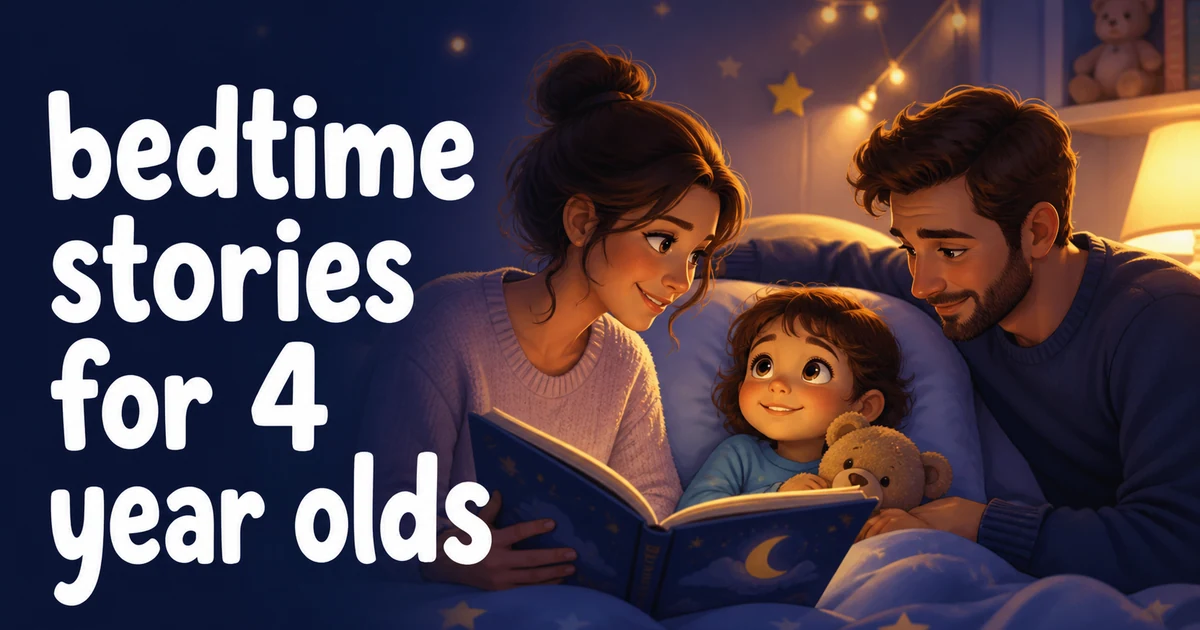
The same story can help one evening and fail on another because context matters. If imagined monsters and shadows, begin with a brave-character rehearsal, observe the response, and adjust the experience instead of blaming the child or the book.
Why a story can help
Language for inner experience is easier to learn when attached to visible events. A tightening body, a changed voice, a missed cue, and a repaired mistake give words such as worried, frustrated, relieved, or proud something concrete to mean.
Shared reading combines language, attention, emotion, and connection. The adult's voice and pauses help organise the experience, while the plot gives cause and effect a memorable shape. This is why a brave-character rehearsal can be more useful than repeating an abstract instruction.
Meaning grows through prediction. When a child anticipates what a character might do, they combine memory, emotion, and cause-and-effect reasoning. The prediction does not need to be correct; explaining it is the valuable cognitive work.
Children can repeat a rule before they can use it under pressure. Working memory, impulse control, language, and emotional regulation develop gradually. Stories reduce the demand by showing naming fears inside a sequence: a character notices a problem, tries something, sees the effect, and adjusts.
Choice improves engagement when it is bounded. Offering two suitable stories—or two ways to participate—preserves the adult's responsibility for safety and fit while giving the child meaningful agency. That is often more effective than either total control or unlimited choice.
A character's failed attempt is instructional data. It lets the child compare intention with impact and see how feedback changes the next choice, without making the child's own mistake the centre of the conversation.
Read the need before choosing the book
Ask which part is hardest: beginning, continuing, finishing, or recovering afterward. A story about initiation will not solve a finishing problem, even when both appear to adults as imagined monsters and shadows.
Before choosing a story, observe one ordinary episode involving imagined monsters and shadows. Note the trigger, the child's body and words, the adult response, and the recovery. A pattern across several days is more informative than the family's hardest single moment.
Write down what “better” would look like in one week. Choose a modest indicator such as a faster recovery, one new phrase, or accepting help sooner. This prevents the family from dismissing real progress because the entire challenge has not vanished.
Check for conflicting adult expectations. If caregivers use different rules or cues, a child may be navigating ambiguity rather than refusing. Agree on one simple version of a brave-character rehearsal.
Check the emotional temperature. If either adult or child is already overwhelmed, teaching is unlikely to land. Regulate first, reconnect second, and bring in the story later when curiosity has returned.
Ask how much language the moment demands. During imagined monsters and shadows, the child may need a gesture, picture, or two-word cue before they can use a complete sentence about naming fears.
What to look for
Reject stories that solve the problem through humiliation, fear, or sudden personality change. A useful ending shows support, practice, repair, or a realistic next step—not obedience produced by shame.
Check whose experience is centred. Stories about difference, disability, culture, or family structure should give affected characters full motives and agency rather than using them merely to teach another character a lesson.
Check developmental fit across language, plot, and length. Familiar words can support a new idea; an intricate plot can make a simple lesson disappear. Stop before fatigue turns shared reading into endurance.
Consider the supporting characters. Helpful adults and peers should guide without taking over, set boundaries without humiliating, and allow the protagonist to retain meaningful agency.
Match emotional intensity before matching topic. A story about the “right” issue can still be wrong if it is frightening, shaming, or too close to a fresh event. Preview the opening tension, the hardest scene, and the ending before reading aloud.
Inspect the ending closely. Resolution should come from a comprehensible choice, support, discovery, or repair. Sudden rescue and unexplained transformation weaken the connection between action and outcome.
How to read it without turning it into a lesson
Avoid turning every page into a question. Comment, wonder aloud, and sometimes keep reading. Conversation supports comprehension; interrogation competes with immersion.
Invite the child to choose where to pause. Their selected moment may reveal humour, confusion, fear, or identification that an adult-led discussion would overlook.
If the child rejects the story, do not sell it harder. Ask whether the problem is the topic, length, mood, or timing. Choosing a different story preserves trust and teaches that reading preferences can be expressed respectfully.
When several children share the story, vary the doorway into it. One may repeat a line, one may track the problem, and another may watch the pictures. Equal participation does not require identical participation.
Follow the child's mode of participation. They may listen while moving, point at pictures, supply repeated words, or interrupt with a personal connection. Participation does not need to look still or school-like to be meaningful.
Invite prediction with a reversible prompt: “I wonder what might happen.” If the child does not respond, offer your own thought and keep going. Silence can still be engaged listening.
Move from story to practice
Practise at half difficulty. Shorten the wait, reduce the number of steps, or role-play with a cooperative partner. Successful small repetitions build a pathway that can later survive a harder context.
Ask the child to rank three possible responses for safety, kindness, and usefulness. There may not be one winner. Explaining the trade-off turns naming fears into judgment that can travel across contexts.
Let the family create a sequel set one week later. Ask what the character remembers, still finds difficult, and does when the first plan fails. A sequel presents learning as ongoing rather than magically complete.
Practise changing the plan when an obstacle appears. Ask, “What is plan B if that does not work?” Flexible backup planning prevents the story from teaching a brittle one-solution rule.
After reading, rehearse a brave-character rehearsal for no more than two minutes. Let the child play the character, then swap roles. End while the attempt still feels possible; the purpose is to make the response familiar, not to prove mastery.
Invite drawing or building instead of discussion. The child might draw the hardest scene, construct a safer ending, or give the character a tool. Nonverbal responses can reveal understanding that direct questions miss.
What progress actually looks like
Ask whether the routine reduced shame and conflict as well as whether behaviour changed. An approach that produces compliance by damaging trust is not a successful reading intervention.
Stop using the story when it has done its job or becomes irritating. A resource can be useful and still have an endpoint. Keep the skill cue, thank the story, and make room for new interests.
Notice whether repair begins sooner. A child who still makes mistakes but returns, checks impact, or accepts reconnection is developing a crucial part of naming fears.
Use the child's spontaneous references as evidence. Mentioning a character, repeating a line in play, or proposing a different ending suggests that the narrative has become available for thinking.
Look for transfer rather than exact imitation. The child may not repeat the character's words but may pause, seek proximity, or propose a compromise. Different behaviour can express the same developing naming fears.
Measure participation in the practice itself. Willingness to role-play, suggest a line, or revisit the turning point can precede change during the higher-pressure real event.
Important limits
Be careful with reward-heavy extensions. Stickers and points can make a reading interaction feel transactional. Start with choice, connection, visible progress, and a task sized for success.
Avoid using a real peer or sibling as the obvious villain in a personalized plot. Composite or fictional characters protect relationships and keep the story focused on options rather than blame.
Preview generated and online content. Check emotional tone, accuracy, privacy, representation, links, ads, and the ending before sharing it with a child. Keep sensitive personal details out of digital story tools.
Pause if the child becomes distressed, unusually quiet, or eager to leave. Offer comfort and choice without demanding an explanation. A topic can be revisited later with more distance or appropriate support.
A story is not an assessment or treatment. Seek qualified support when the pattern is intense, persistent, unsafe, distressing, or interferes with daily life across settings.
Keep private details private. Personalisation needs only enough context to create relevance; names, locations, school identifiers, diagnoses, and family events should not be entered into a tool without a clear need and privacy review.
Try a matched TalePillow story
Explore the TalePillow story library for a ready-made narrative connected with naming fears. If the challenge is highly specific, create a personalized story using a familiar interest, one believable obstacle, and a brave-character rehearsal. Always preview the result before sharing it with a child.
Two questions families often ask
Are digital stories as useful as print? They can be when the experience protects joint attention. Disable notifications and autoplay, reduce decorative interaction, and keep the conversation.
Should siblings read the same story? They can, but use layered participation. A younger child may point or repeat; an older child may infer motives or compare choices.
Sources and further reading
- American Academy of Pediatrics: shared reading guidance
- Harvard Center on the Developing Child: executive function
The goal is not to use a story to make a child comply. It is to make naming fears easier to understand, discuss, and practise while protecting connection. For imagined monsters and shadows, begin with a brave-character rehearsal and adjust from what the child shows you.
Turn the idea into a story your child can rehearse
Choose a relevant TalePillow story below, or create a personalized version around the exact skill your family is practicing.