

What will your child learn?
- A clear no does not need an argument.
- Asking first helps play feel safe and mutual.
- A different kind of connection can still be kind.
Loading content
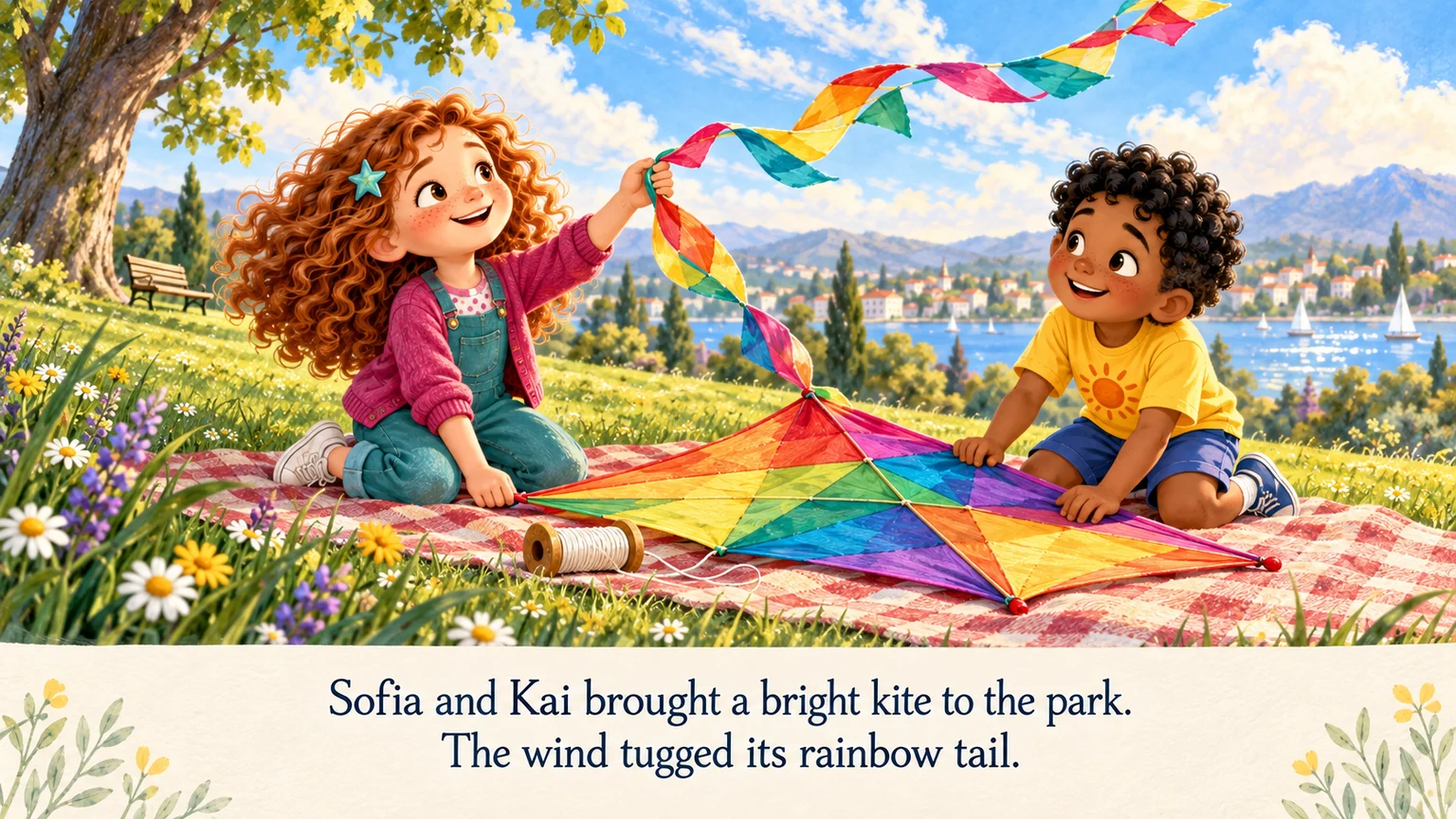
Sofia and Kai brought a bright kite to the park.
5–8 years old • 5 minute • Respecting yes, no, and maybe
Sofia and her friend learn that play feels better when everyone can ask, answer, and change their mind. A kite becomes a bright reminder that yes, no, and maybe all deserve respect.
 5:00Amara and the Open Spot5–8 years old • Joining play with confidence
 5:00Noor and the Safe Grown-Up Circle5–8 years old • Knowing when to stop and check
 7:00Zoe’s Yes, No, and Tell Plan5–8 years old • using body boundaries and seeking safe help
 7:00Ari and the Two Loop Challenge5–8 years old • learning to tie shoelaces patiently
Full text
15 pages, approximately 5 minutes while listening. Enter the child’s name in the reader above so the narrator can call the child’s name correctly.
Sofia and Kai brought a bright kite to the park. The wind tugged its rainbow tail.
Kai opened his arms. Sofia stepped back. “No hug today, please.”
Kai stopped. “Okay.” He waved instead. Sofia waved back.
Later, Sofia asked, “Can I hold the kite?” Kai said, “Not yet. I am still flying it.”
Sofia felt disappointed. She took a breath. “Okay. Tell me when it is my turn.”
Kai passed her the spool. “Now?” he asked. Sofia smiled. “Yes, now.”
The kite climbed. Sofia felt the string hum. Kai kept one hand near hers, just in case.
“High-five?” Sofia asked. Kai chose a fist bump. They found a way that felt good to both.
The kite dipped, then rose again. Questions made space for better play.
My yes, no, and maybe matter. So do yours.
The next day, Kai asked before borrowing Sofia's markers. Sofia said, “Yes, after I finish the sun.”
When Sofia felt unsure about a game, she said, “Maybe. Tell me the rules first.”
Kai explained. Sofia listened, then chose to watch one round. Her choice stayed hers.
“No thanks,” Kai said to a noisy idea. Sofia nodded and suggested a quieter one.
Good friendship leaves room for honest answers—and keeps looking for ways to play with care.
For parents
Sofia's Yes, No, Maybe Kite is an illustrated daily-life story for children 5–8 years old. Through a warm, believable situation, it shows a practical sequence in action: ask before physical contact or borrowing, answer honestly, respect another child's no, and offer a comfortable alternative. The ending gives parents a natural way to start a conversation.
Children 5–8 years old who are practising respecting yes, no, and maybe during ordinary family, school, or community moments.
This story gives families a gentle rehearsal when children need everyday language for asking, answering, accepting no, and choosing another way to connect, without turning the difficult moment into a lecture.
Sofia and her friend learn that play feels better when everyone can ask, answer, and change their mind. A kite becomes a bright reminder that yes, no, and maybe all deserve respect.
Short answer, easy to look up
The story turns respecting yes, no, and maybe into a concrete choice: the character notices a problem, tries one idea, learns from what happens, and finds a safer or kinder next step.
Consent is not only a serious safety lesson; it is a daily relationship skill. Model that a no is useful information, not a rejection that needs persuasion.
Yes. The short pages and clear visual actions suit a calm read-aloud for 5–8 years old; pause for the child’s observations without turning the story into a test.
Story Discussion
Log in to share your thoughts and join the conversation for this story.
Log in to commentNo comments yet. Be the first to share your thoughts on this adventure!