

What will your child learn?
- A not-yet answer is not always a no forever.
- Offering a useful role can open a door to play.
- Patience and persistence can coexist.
Loading content
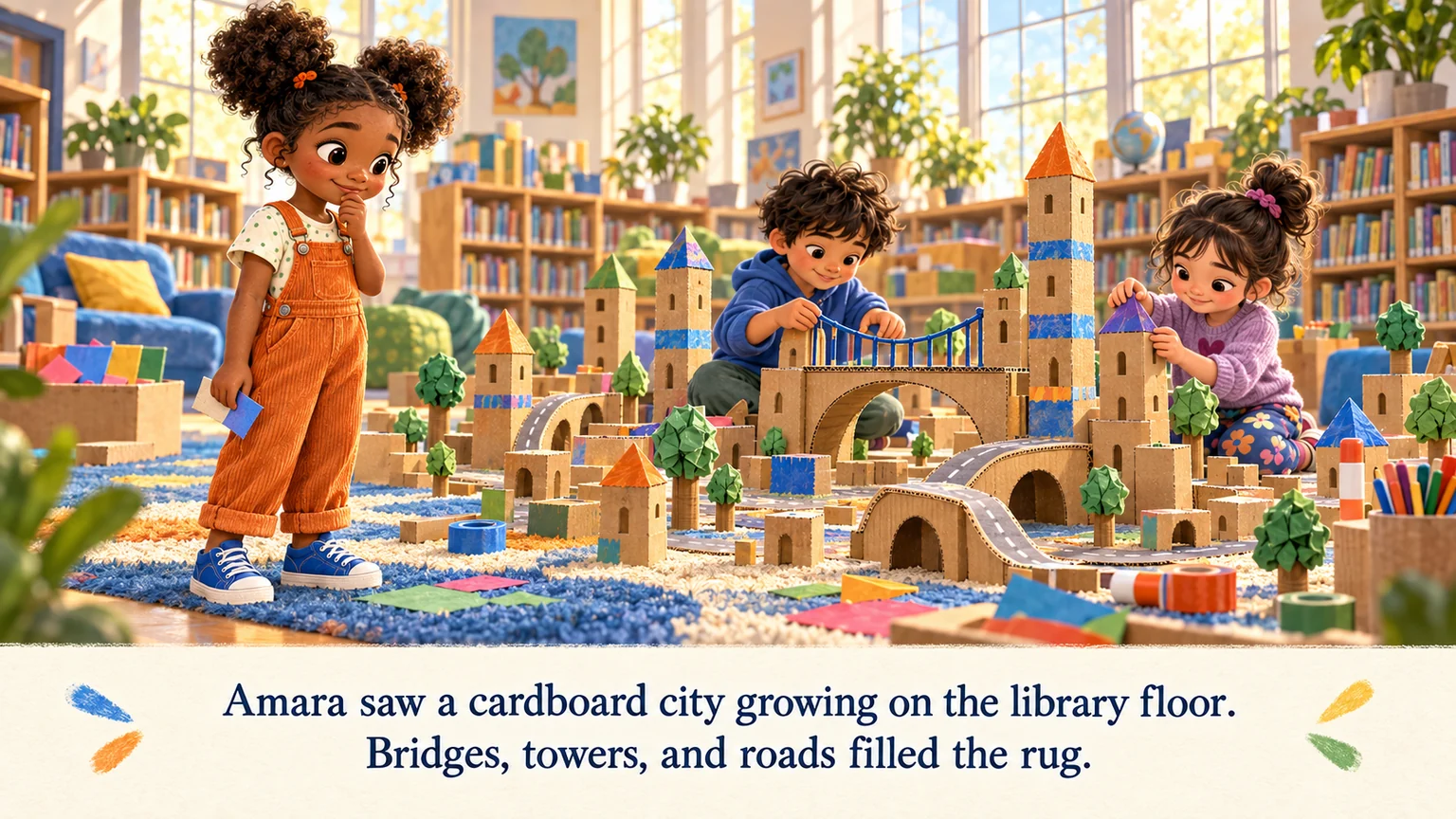
Amara saw a cardboard city growing on the library floor.
5–8 years old • 5 minute • Joining play with confidence
Amara wants to join a group building a cardboard city. When the timing is not quite right, she handles the disappointment, offers a useful role, and finds her way into the play.
 5:00Sofia's Yes, No, Maybe Kite5–8 years old • Respecting yes, no, and maybe
 5:00Noor and the Safe Grown-Up Circle5–8 years old • Knowing when to stop and check
 7:00Zoe’s Yes, No, and Tell Plan5–8 years old • using body boundaries and seeking safe help
 7:00Ari and the Two Loop Challenge5–8 years old • learning to tie shoelaces patiently
Full text
15 pages, approximately 5 minutes while listening. Enter the child’s name in the reader above so the narrator can call the child’s name correctly.
Amara saw a cardboard city growing on the library floor. Bridges, towers, and roads filled the rug.
Amara wanted to join. Her hands held the straps of her overalls while she watched.
“Can I play too?” Amara asked. The builders looked at their half-finished bridge.
“We need to finish this part,” said Kai. “You can watch for now.” It was not-yet, not never.
Amara felt disappointed. She took one step back and thought: What job could help?
“I could make road signs,” Amara offered. “Would that help your city?”
The builders looked up. “Yes! We need signs for the bridge and the park.”
Amara drew arrows and trees. Her road signs made the city easier to explore.
When the bridge was ready, the group made room beside them. Amara brought the next idea.
Joining can start with a question, a kind offer, and patience.
The following week, Amara saw a new group building a paper garden. She remembered how it felt to watch.
“Would you like to watch or help?” Amara asked. The child pointed to the green paper.
Amara made space for the leaves. The new builder chose where each one would grow.
The garden became bigger than one person's idea. Everyone brought something useful.
A good way into play can become a good way to welcome someone else.
For parents
Amara and the Open Spot is an illustrated daily-life story for children 5–8 years old. Through a warm, believable situation, it shows a practical sequence in action: ask to join play, listen to a not-yet answer, offer a helpful role, and wait for an opening without giving up. The ending gives parents a natural way to start a conversation.
Children 5–8 years old who are practising joining play with confidence during ordinary family, school, or community moments.
This story gives families a gentle rehearsal when a child wants to join a group but does not know what to say when the group is already focused on a plan, without turning the difficult moment into a lecture.
Amara wants to join a group building a cardboard city. When the timing is not quite right, she handles the disappointment, offers a useful role, and finds her way into the play.
Short answer, easy to look up
The story turns joining play with confidence into a concrete choice: the character notices a problem, tries one idea, learns from what happens, and finds a safer or kinder next step.
A child can be welcomed without demanding that a group abandon its play. Practise flexible entry phrases such as “Can I watch?” or “Could I help with a job?”
Yes. The short pages and clear visual actions suit a calm read-aloud for 5–8 years old; pause for the child’s observations without turning the story into a test.
Story Discussion
Log in to share your thoughts and join the conversation for this story.
Log in to commentNo comments yet. Be the first to share your thoughts on this adventure!