

What will your child learn?
- A small sequence can make a big routine feel possible.
- Mistakes are part of getting ready.
- Independence includes knowing when to ask for help.
Loading content
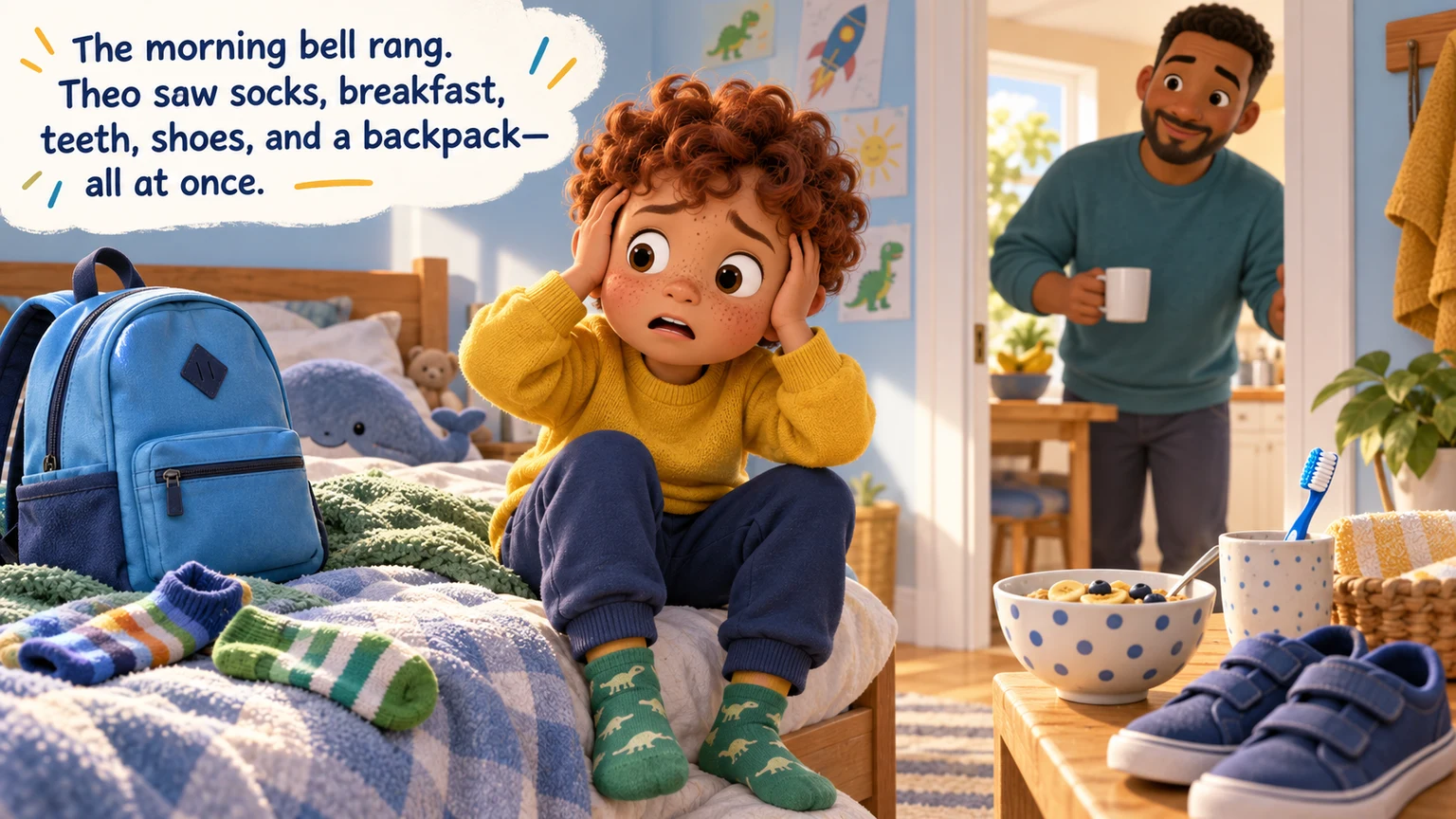
The morning bell rang.
4–7 years old • 5 minute • Building morning independence
Theo wants to be ready on time, but a busy morning feels like one giant problem. A simple picture map helps him see the next step, recover from a spill, and leave with growing confidence.
 8:00Mateo and the Golden Squash4–7 years old • Exploring new foods without pressure
 8:00Ivy and the Tidy-Up Orchestra4–7 years old • Tackling tidy-up in small steps
 5:00Elliot and the Waiting Moon4–7 years old • Waiting and taking turns
 5:00Asha and the Screen-to-Sleep Lantern4–7 years old • Moving from screens to sleep
Full text
15 pages, approximately 5 minutes while listening. Enter the child’s name in the reader above so the narrator can call the child’s name correctly.
The morning bell rang. Theo saw socks, breakfast, teeth, shoes, and a backpack—all at once.
“I can't get ready!” Theo cried. His feet felt stuck to the floor.
Dad unfolded a tiny map. “Wash. Dress. Eat. Shoes. One picture at a time.”
Theo pointed to the first picture: wash. The whole morning did not need to happen yet.
Water splashed. Shirt on. Socks found. Theo moved one small picture along the map.
Then cereal tipped over. Theo's eyes widened. The morning felt giant again.
Theo took a breath. “Dad, I need a cloth.” He wiped the table and chose the next picture.
One shoe was hiding under the chair. Theo looked, found it, and tied the first loop.
At the door, Theo checked his map. Every picture had moved. He was ready enough.
A map did not make the morning perfect. It made the next step clear.
On Saturday, Theo made a new map for the park: shoes, water, hat, and check-in.
The hat blew away. Theo stopped, looked at the picture, and chose water first.
“Dad, can you help me find the hat?” He asked without giving up on the whole outing.
The hat was under the bench. Theo tucked it into his bag and checked the next picture.
A clear next step can travel with us—even when the plan needs to change.
For parents
Theo's Tiny Morning Map is an illustrated daily-life story for children 4–7 years old. Through a warm, believable situation, it shows a practical sequence in action: follow a short morning sequence, choose one next step, recover from a mistake, and ask for help when needed. The ending gives parents a natural way to start a conversation.
Children 4–7 years old who are practising building morning independence during ordinary family, school, or community moments.
This story gives families a gentle rehearsal when a child knows what needs to happen in the morning but feels overwhelmed when every task arrives at once, without turning the difficult moment into a lecture.
Theo wants to be ready on time, but a busy morning feels like one giant problem. A simple picture map helps him see the next step, recover from a spill, and leave with growing confidence.
Short answer, easy to look up
The story turns building morning independence into a concrete choice: the character notices a problem, tries one idea, learns from what happens, and finds a safer or kinder next step.
Independence grows from a manageable sequence, not from expecting a child to hold the whole morning in their head. Keep the map short and practise it when nobody is late.
Yes. The short pages and clear visual actions suit a calm read-aloud for 4–7 years old; pause for the child’s observations without turning the story into a test.
Story Discussion
Log in to share your thoughts and join the conversation for this story.
Log in to commentNo comments yet. Be the first to share your thoughts on this adventure!